Introduction: Why Thermal Payload Selection Matters for Oil & Gas Inspections
Every hour of unplanned downtime at an oil and gas facility costs between $250,000 and $850,000 in lost production, according to industry analysis of thermal imaging programs. A single compressor failure or electrical fault can trigger cascading shutdowns that take days to resolve. The challenge is that most of these failures don’t happen suddenly—they develop over weeks, presenting detectable thermal signatures 15 to 45 days before catastrophic failure. The right thermal payload catches those early warning signs; the wrong one misses them entirely.
The market now offers dozens of thermal payload options with specifications that are easy to compare on paper but difficult to translate into real-world detection capability. A 640×512 resolution sensor with high thermal sensitivity might be essential for finding small methane leaks, yet overkill for routine electrical inspections. Meanwhile, safety certifications for hazardous area operations, payload weight limits, and compatibility with existing drone platforms add further layers of complexity.
This guide provides a decision framework that maps specific oil and gas inspection use cases—gas leak detection, electrical inspections, and insulation checks—to the thermal payload specifications that actually matter for each scenario. We’ll cover the three main industry segments—upstream production, midstream pipeline transport, and downstream refining—because each demands different thermal inspection approaches based on equipment criticality and operating temperatures. By the end, you’ll know exactly which specifications to prioritize for your inspection program, which certifications are non-negotiable, and how to avoid the costly mistake of purchasing a payload that can’t do the job.
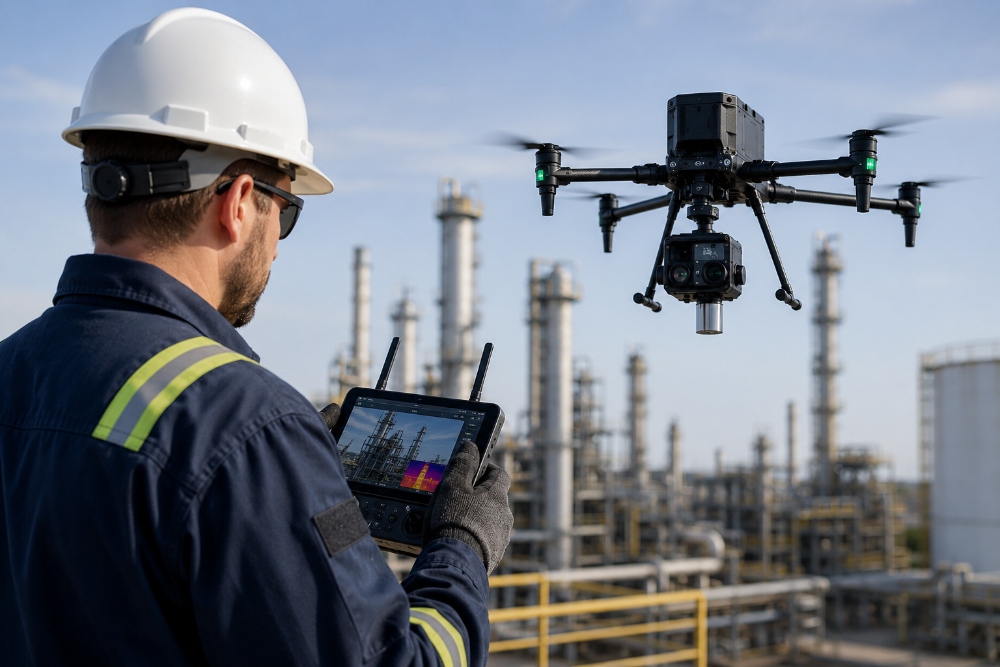
Step 1: Define Your Inspection Use Cases
Before comparing sensor specs, map the specific inspection tasks you need to perform. The payload that excels at finding methane leaks will underperform on electrical fault detection—and vice versa. Your use cases determine every downstream specification decision, from thermal resolution to whether you need optical gas imaging (OGI) capability.
Common Oil & Gas Inspection Use Cases
Gas leak detection (methane/VOC). Escaping gas creates a visible cooling effect through Joule-Thomson expansion, appearing as a cold plume against the warmer background. Detecting these requires either an OGI camera tuned to hydrocarbon absorption bands or a high-sensitivity thermal sensor (NETD ≤ 50 mK) with sufficient resolution to resolve small plumes at distance. Standard thermal cameras without gas-detection tuning will miss most fugitive emissions.
Electrical inspections. Loose connections, overloaded circuits, and failing insulation develop hot spots that precede 40% of unplanned shutdowns in oil and gas facilities. These inspections demand radiometric capability—the ability to measure absolute temperatures, not just show relative differences—so you can quantify severity against NFPA 70B thresholds. A 640×512 resolution sensor lets you resolve individual bus bar connections and terminal lugs from a safe standoff distance.
Insulation and mechanical checks. Corrosion under insulation (CUI), refractory degradation, and failing bearings all produce subtle thermal signatures. Pump bearings typically run at 140–160°F, with failure indicated by a gradual rise toward 180°F+ over 2–4 weeks. Furnace tube hot spots appear 50–100°F above surrounding tubes. These applications need good thermal sensitivity and a wide temperature range, but rarely require OGI.
Prioritize by Criticality and Frequency
| Use Case | Thermal Signature | Key Specs Required | Typical Targets |
|---|---|---|---|
| Gas leak detection | Cold plume (Joule-Thomson cooling) | OGI or NETD ≤ 50 mK, high resolution | Valve stations, flanges, seals |
| Electrical faults | Hot spots on connections/terminals | Radiometric, 640×512 min | Switchgear, MCCs, cabinets |
| Insulation/CUI | Heat loss patterns, uneven surfaces | Good NETD, wide temp range | Piping, vessels, tanks |
| Rotating equipment | Bearing temperature rise | Radiometric, trend-capable | Pumps, compressors, motors |
Create a prioritized list of your top inspection targets, ranked by failure consequence and inspection frequency. A facility that inspects compressor stations weekly has different payload requirements than one performing quarterly flare stack surveys. This list becomes the reference point for every specification decision in the following steps—when two payload specs conflict, the one serving your highest-priority use case wins.


Step 2: Understand Key Thermal Payload Specifications
Thermal camera specifications look straightforward on a datasheet, but each one changes what you can actually detect in the field. Understanding these five parameters—resolution, sensitivity, radiometric capability, temperature range, and spectral band—lets you compare payloads meaningfully rather than by marketing claims.
Thermal Resolution and Detection Range
Thermal resolution (e.g., 640×512 vs. 336×256) determines how many temperature measurement points form the image. A 640×512 sensor captures roughly four times the data of a 336×256 sensor, which directly translates to detection range. At a given distance, each pixel on the higher-resolution sensor covers a smaller ground area, so you can resolve smaller targets—a leaking flange, a failing bus bar connection—from farther away.
For gas leak detection, this matters critically. A small methane plume at 30 meters might occupy only a few pixels on a 336×256 sensor, making it nearly invisible. The same plume on a 640×512 sensor spans enough pixels to be clearly identifiable. For electrical inspections, higher resolution lets you isolate individual terminal lugs and connection points within a crowded switchgear cabinet rather than seeing only a general hot zone.
The trade-off is cost and data volume. High-resolution sensors cost significantly more, and the resulting imagery requires more storage and processing time. If your primary use case is wide-area insulation surveys where targets are large, a 336×256 sensor may be adequate.
Thermal Sensitivity (NETD) and Its Role in Leak Detection
Thermal sensitivity, expressed as NETD (Noise Equivalent Temperature Difference), describes the smallest temperature difference the sensor can distinguish. Typical industrial thermal cameras range from 30 to 50 mK. Lower values mean better sensitivity.
This specification becomes decisive for gas leak detection. The Joule-Thomson cooling effect from an escaping gas leak produces a temperature differential of only a few degrees against the background—sometimes less. A camera with 50 mK NETD can resolve this; one with 80 mK or higher may miss it entirely. For electrical inspections, where hot spots typically run 10–40°C above ambient, NETD is less critical. A 50 mK sensor is a safe baseline for mixed-use programs; choose 30 mK if gas detection is a priority.

Radiometric vs. Non-Radiometric Cameras
A radiometric camera measures absolute temperatures for every pixel in the image; a non-radiometric camera displays only relative temperature differences. This distinction determines whether your inspection data supports quantitative analysis.
For electrical inspections, radiometric capability is non-negotiable. You need to compare a measured connection temperature against NFPA 70B thresholds to classify severity and prioritize repairs. The same applies to rotating equipment: a pump bearing trending from 150°F to 170°F over successive inspections requires absolute measurements, not just a visual “hotter than before.”
Non-radiometric cameras are cheaper and sufficient for simple anomaly screening—finding which compressor in a row is running hot. But they cannot produce the trend data that justifies maintenance decisions. If your program requires documented temperature readings for compliance or condition monitoring, radiometric is the only option.
Temperature Range and Spectral Band
The camera’s temperature range must cover your facility’s equipment extremes. Downstream refining assets—furnace tubes, catalytic crackers, flare stacks—can exceed 500°C. Cryogenic processes and cold-weather pipeline operations may require measuring below −20°C. A payload rated only to 150°C will saturate on high-temperature targets, producing useless imagery. Verify the range against your hottest and coldest inspection targets before purchase.
Spectral band also matters. Most drone thermal payloads use long-wave infrared (LWIR, 8–14 µm), which suits general inspection work. Mid-wave infrared (MWIR, 3–5 µm) is used for high-temperature targets and optical gas imaging (OGI) of hydrocarbon leaks. If methane detection is a core requirement, you need an OGI-tuned payload—standard LWIR cameras will not visualize gas plumes.
| Specifiche | What It Determines | Typical Range | Priority by Use Case |
|---|---|---|---|
| Thermal resolution | Image detail, detection range | 336×256 to 1280×1024 | High for gas leaks, electrical |
| NETD | Smallest detectable ΔT | 30–50 mK | Critical for gas leaks |
| Radiometric | Absolute temperature data | Yes/No | Required for electrical, rotating equipment |
| Temperature range | Equipment coverage | −40°C to +550°C | Match to facility extremes |
| Spectral band | Gas detection capability | LWIR vs. MWIR/OGI | OGI required for methane |
Frame rate and field of view are secondary but worth checking. A 30 Hz frame rate is standard and adequate for most inspections; higher rates matter only for fast-moving targets. Wide-field lenses cover more area per flight but reduce detail at distance—narrower fields suit close-in electrical work. Choose based on your typical standoff distances.
For a deeper look at how these specifications translate into real payload options, see our guide to thermal cameras for industrial UAVs and the electro-optical systems overview covering LWIR and MWIR trade-offs.

Step 3: Match Payload Capabilities to Your Use Cases
With your use case priorities from Step 1 and the specification fundamentals from Step 2, you can now map requirements to specific payload configurations. The table below translates each common oil and gas inspection scenario into minimum recommended specifications.
| Use Case | Min. Resolution | Min. NETD | Radiometric Required? | OGI Needed? | Typical Payload Class |
|---|---|---|---|---|---|
| Gas leak detection (methane/VOC) | 640×512 | ≤50 mK (30 mK preferred) | Sì | Yes (for methane) | OGI-tuned LWIR or MWIR |
| Electrical inspections | 336×256 (640×512 preferred) | ≤50 mK | Sì | No | Dual-sensor EO/IR |
| Insulation/CUI checks | 336×256 | ≤50 mK | Sì | No | Dual-sensor EO/IR |
| Rotating equipment trending | 336×256 | ≤50 mK | Sì | No | Dual-sensor EO/IR |
| Flare stack / high-temp assets | 640×512 | ≤50 mK | Sì | No | Wide temp range (≥550°C) |
Gas Leak Detection Demands the Highest Specs
If methane or VOC detection is a core requirement, you need an optical gas imaging (OGI) payload—a standard LWIR thermal camera will not visualize gas plumes. The MFE Detect LW, for example, is a long-wave infrared OGI payload designed specifically for aerial methane visualization, turning a standard UAV into a flying gas detector for LDAR workflows. For non-OGI thermal leak screening, a 640×512 radiometric camera with NETD ≤50 mK is the practical minimum; at 30 meters, a small plume occupies only a few pixels on a 336×256 sensor, making it nearly invisible.
Electrical and Mechanical Inspections: Resolution Matters More Than OGI
For electrical inspections, a 336×256 radiometric camera can identify hot spots, but 640×512 resolution lets you isolate individual terminal lugs and bus bar connections within a crowded switchgear cabinet. The same logic applies to rotating equipment: a pump bearing trending from 150°F to 170°F over successive inspections requires absolute temperature data, so radiometric capability is non-negotiable. The QJ-ET-40 integrates a 640×512 thermal imager with a 40× optical zoom EO camera, making it suitable for both electrical component identification and thermal measurement in a single pass.
The Dual-Sensor Advantage
For most mixed-use inspection programs, a dual-sensor payload (EO + thermal) is worth the additional cost. The visible camera provides spatial context—valve numbers, flange locations, equipment tags—that makes thermal data interpretable in reports and actionable for maintenance crews. The MMC HT18R combines a 48MP visible camera with a 640×512 thermal imager and laser rangefinder, enabling comprehensive day-night data collection in one payload. When comparing options, verify that the EO and thermal sensors are boresighted so the visible and IR images align precisely; misalignment creates confusion during analysis and undermines report credibility.
Step 4: Consider Cost, Training, and Total Cost of Ownership
The payload’s sticker price is only the first line of a budget that spans training, software, calibration, and downtime. A complete total cost of ownership (TCO) analysis prevents the common mistake of buying a capable sensor and then discovering you can’t afford to operate it properly.
Price Ranges by Payload Class
| Payload Class | Typical Price Range | Best For | Key Cost Drivers |
|---|---|---|---|
| Basic non-radiometric thermal (336×256) | $5,000–$10,000 | Anomaly screening, simple surveys | Lower sensor cost, no radiometric calibration |
| Radiometric dual-sensor (640×512) | $15,000–$30,000 | Electrical, mechanical, insulation inspections | Radiometric calibration, EO/IR boresighting |
| OGI / gas detection payloads | $40,000–$80,000+ | Methane and VOC leak detection | Specialized spectral filtering, gas quantification software |
The spread between classes is significant, but the gap reflects real capability differences. A $7,000 non-radiometric camera cannot produce the absolute temperature data required for NFPA 70B severity classification or bearing trend analysis—you’ll need the $20,000+ radiometric class for those workflows.
Training and Software Costs
Budget for operator competency, not just hardware. Level 1 thermography certification costs $2,000–$3,000 per technician and covers camera operation, basic heat transfer, and emissivity fundamentals—training that measurably improves data quality and reduces false positives. Level 2 certification ($3,000–$5,000) adds advanced radiometric analysis and report writing. Add $1,500–$4,000 annually for thermal analysis software licenses (FLIR Thermal Studio, DJI Thermal Analysis Tool) and reporting platforms.
Calculating ROI
The payback math favors higher-spec payloads when you factor in avoided failures. A $20,000 OGI payload that detects a methane leak before it triggers an EPA violation or product loss can save $50,000+ in a single inspection cycle. Electrical fault detection follows the same logic: electrical failures cause 40% of unplanned shutdowns, with production losses of $250,000–$850,000 per hour at major facilities (Thermal Imaging AI for Equipment Inspection in Oil & Gas Complete Guide). One prevented shutdown pays for the payload several times over.
Also factor in calibration—$500–$1,500 annually for radiometric accuracy verification—and a 3–5 year replacement cycle for uncooled microbolometer sensors. When these costs are spread across the inspection program’s lifetime, the payload typically represents 30–50% of total program cost; training, software, and maintenance make up the rest.

Conclusion: Making the Final Decision
Selecting the right thermal payload comes down to a disciplined sequence: define your inspection use cases first, then translate those into specification requirements, verify safety and environmental durability, confirm compatibility with your drone and software, and finally weigh total cost of ownership against the value of early fault detection. A midstream operator we consulted followed exactly this path—they prioritized methane leak detection across 100+ miles of pipeline, which led them to an OGI-tuned payload with 640×512 resolution and radiometric output. The payload cost roughly four times more than a basic thermal camera, but it detected a fugitive emission during its first month of service that would have gone unnoticed until the next quarterly LDAR survey, avoiding a potential EPA violation and product loss that exceeded the payload’s price several times over.
The right payload is not the most expensive one on the market—it is the one that serves your highest-priority inspection target without exceeding your operational constraints. Use the framework from this guide as your evaluation checklist: confirm your use case priorities, verify minimum specs (resolution, NETD, radiometric capability), request certification documents for hazardous area operation, test compatibility with your exact drone model, and calculate true TCO including training and calibration.
If you are still weighing options, the Dasion team can help you map your specific inspection targets to the right payload configuration. Contattateci for personalized recommendations or a quote, or explore our facility inspection solutions to see how our EO/IR payloads integrate with common industrial drone platforms.
Domande frequenti
What thermal resolution do I need for gas leak detection?
For methane or VOC leak detection, a 640×512 resolution sensor is the practical minimum. At 30 meters, a small plume occupies only a few pixels on a 336×256 sensor, making it nearly invisible; the same plume on a 640×512 sensor spans enough pixels to be clearly identifiable. For optical gas imaging (OGI) workflows, the MFE Detect LW uses long-wave infrared tuned to hydrocarbon absorption bands specifically for aerial methane visualization. If you’re screening for leaks without OGI capability, pair 640×512 resolution with a thermal sensitivity of ≤50 mK—ideally 30 mK—to resolve the subtle Joule-Thomson cooling effect.
What is the minimum NETD for oil and gas inspection?
A NETD of 50 mK is the safe baseline for mixed-use programs covering electrical, mechanical, and insulation inspections. Choose 30 mK if gas leak detection is a priority, since escaping gas produces temperature differentials of only a few degrees against the background.
Are there ATEX-certified thermal payloads for drones?
Most drone thermal payloads are not ATEX certified. Explosion-proofing a gimbal-mounted camera with cooling fans, rotating motors, and exposed connectors is technically challenging and expensive, so manufacturers rarely pursue certification. This doesn’t prevent operation in Zone 2 areas—it requires an operational safety case. As demonstrated in DJI’s enterprise workflow, drones can fly far enough from potential ignition sources that “we have no explosion concern at all.” Your site’s permit-to-work system will define acceptable standoff distances, and some facilities require a gas detector on the drone or a hot-work permit.
What is the difference between radiometric and non-radiometric thermal cameras?
A radiometric camera measures absolute temperatures for every pixel; a non-radiometric camera displays only relative differences. For electrical inspections, radiometric capability is non-negotiable—you need to compare measured connection temperatures against NFPA 70B thresholds to classify severity. The same applies to rotating equipment: a pump bearing trending from 150°F to 170°F requires absolute measurements, not just a visual “hotter than before.” Non-radiometric cameras suffice for simple anomaly screening but cannot produce the trend data that justifies maintenance decisions.
What are the best practices for setting emissivity on oil and gas equipment?
Set emissivity based on the target material: bare steel typically reads 0.80–0.90, painted surfaces 0.90–0.95, and uncoated aluminum as low as 0.10–0.20. For low-emissivity materials, apply high-emissivity tape or paint to the measurement area, or use a reference emitter of known emissivity. Account for reflected temperature—on sunny days, reflected solar radiation can skew readings on shiny surfaces. Schedule inspections during consistent ambient conditions (early morning or overcast days) to minimize environmental variability between survey cycles.